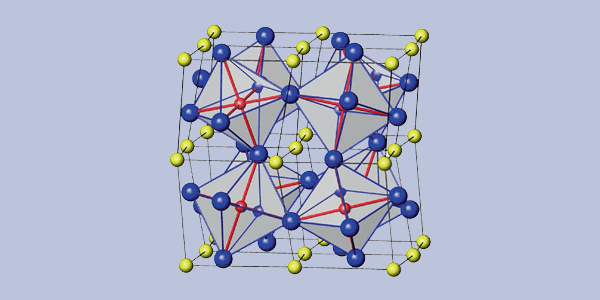
Introduction to magnetic materials
Permanent magnets are made of ferromagnetic materials and their atomic structure has a magnetic torque. The minerals used in making permanent magnets have a disordered molecular arrangement but exhibit magnetic properties under the guidance of an external force such as a magnetic field.
when the ferromagnetic material is magnetized, the internal magnetic domains will be arranged regularly and in one direction form the magnet. Various types of permanent magnetic materials are made, such as ferrites, iron-cobalt-nickel alloys, and rare-earth iron alloys, such as aluminum-nickel-cobalt, cobalt-samarium, boron-iron-neodymium.
Ferrite
Ferrites are a class of magnetic materials whose main component is iron oxide and which have ferromagnetic behavior. The main characteristics of these materials are low conductivity, long life, electrical insulation, resistance to chemical agents, oxidation and corrosion, and good magnetic behavior. Ferrite materials can also be used at microwave frequencies.
Ferrites have many structures, one of the most famous and best structures is hexaferrites, whose main application is to make permanent magnets.
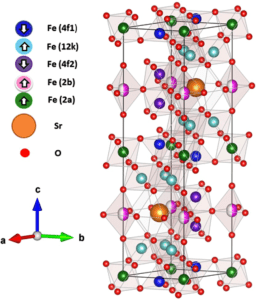
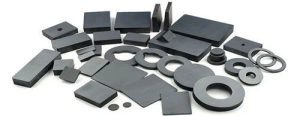
A ceramic magnet, also known as a ferrite magnet, is a permanent magnet made from a combination of iron oxide and other compounds. They are a human-made magnet produced by heating two elements to over 2000 degrees Fahrenheit, which causes a chemical reaction that converts the mixture of the two elements into a ferrite material with a magnetic field.
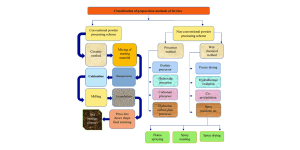
Ferrite production methods are divided into two types: conventional and unconventional.
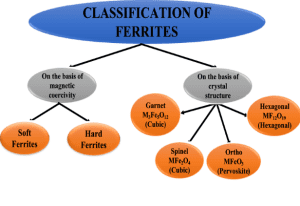
In terms of magnetic properties, ferrites are often classified as “soft” or “hard”, which refers to their low or high magnetic force, and in terms of crystal structure, they are divided into several categories: cubic, hexagonal, and perovskite.
Production process
The main process for producing ferrite magnets includes initial sintering, anisotropic orientation, and final sintering.
In the initial sintering process, calcination is carried out with the formation of hexaferritic crystals in standard density and sizes. This stage is very sensitive due to the oxidation process under pressure and requires the addition of materials to facilitate the formation of the desired crystal structure and achieve the appropriate density for the subsequent stages. This stage is carried out in special furnaces with continuous temperature control.
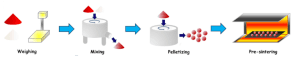
In the anisotropic process, hexanol structures created by initial sintering under a defined and largely uniform grain size are formed under a concentrated magnetic field and an anisotropic magnet piece whose crystal structure is unstable.
In the final sintering stage, unstable crystalline structures are subjected to sintering in more than ten thermal stages, which causes the formation and growth of the crystalline structure of the anisotropic magnet, and the final ceramic is produced in this stage.
Application
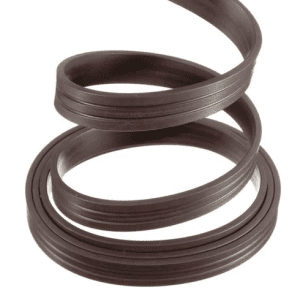
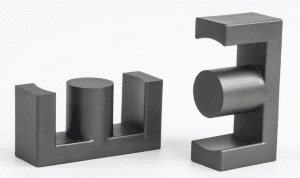
Ferrite-based magnetic materials in various shapes are used to make small inductors and transformers, permanent magnet electric machines, refrigerator door magnets, speakers and microphones, mineral separators, automotive insulators, animal husbandry, agricultural water reinforcement, water purification and fuel consumption reducers, electronic cards, military radars and nuclear equipment, etc.